How Your Baby's Brain Learns Through Play (The Science, Simply Explained)
Between 3 and 12 months, your baby's brain is building one million new neural connections every single second — the right play experiences now shape language, movement, and emotional intelligence for years to come.

In this article
By the time your baby blows out that first birthday candle, their brain will have roughly doubled in size. According to the Harvard Center on the Developing Child, the first year of life sees faster neural growth than at any other point in a human lifespan — and play is the primary engine driving that growth. Not structured lessons. Not screen time. Play.
In this guide you'll understand:
Let's start with the science — then get practical fast.
1. How Your Baby's Brain Learns Through Play (The Science, Simply Explained)
Your baby is not a passive recipient of stimulation — they are an active scientist running experiments every waking minute. The core mechanism is what Harvard researchers call "serve and return": your baby makes a sound or gesture (the serve), you respond with eye contact, words, or touch (the return), and the neural pathway strengthens. Miss too many returns and those pathways weaken. Respond consistently and you literally wire a more capable brain.
The American Academy of Pediatrics (AAP) published a landmark clinical report in 2018 confirming that play — particularly caregiver-guided play — is essential for healthy brain development, social-emotional growth, and stress regulation. The report specifically calls out "back-and-forth interactions" as the single most important ingredient.
Play is not a break from learning — it is how learning happens in the first year of life.
— American Academy of Pediatrics, Clinical Report on the Power of Play (2018)
What "Learning" Looks Like at This Age
Forget flashcards. At 3–12 months, learning looks like:
- Staring at a high-contrast pattern (building visual cortex pathways) - Reaching for a dangling toy (integrating vision + motor planning) - Babbling and waiting for your response (early language scaffolding) - Dropping a spoon repeatedly (cause-and-effect reasoning — annoying but important)
Today's action: Next feed or nappy change, narrate everything you're doing in a slow, sing-song voice. Pause after each sentence and watch your baby's face respond. That pause is the "return" — don't rush past it.
2. Month-by-Month Play Milestones: 3 to 12 Months
Every baby develops on their own timetable, but the AAP and the CDC's "Learn the Signs. Act Early." programme outline a broadly predictable arc. Here's what play typically looks like across the infant year:
| Age Range | What Baby Is Learning | Best Play Type | Key Skills Targeted | Recommended Product | Price Range |
|---|---|---|---|---|---|
| 3–4 months | Tracking moving objects, recognising faces | High-contrast visuals, face-to-face talk, gentle music | Visual tracking, social smiling | UMIKU Dinosaur Baby Gym | $29.99 |
| 4–6 months | Reaching, grasping, rolling | Activity gym, tummy time mat, rattles | Gross + fine motor, cause-and-effect | Blissful Diary Play Gym Mat | $35.99 |
| 6–8 months | Sitting, transferring objects, babbling | Textured toys, mirrors, simple songs | Sensory integration, early language | Jyusmile 8-in-1 Tummy Time Mat | $39.99 |
| 8–10 months | Crawling, object permanence emerging | Hide-and-find games, stacking cups, cloth books | Spatial reasoning, memory | Baby Einstein Kickin' Tunes Gym | $49.97 |
| 10–12 months | Pulling to stand, pointing, proto-words | Push-pull toys, board books, music with movement | Language, balance, imitation | Baby Einstein Farm Explorers Gym | $49.97 |
Today's action: Check the CDC's free "Milestone Moments" booklet (available at cdc.gov) and note where your baby currently sits. It takes five minutes and gives you a personalised play focus for the next month.
3. Tummy Time: The Most Important Play You're Probably Shortchanging
Tummy time is the single highest-yield play activity for infants under 6 months, and yet it's the one parents skip most often because babies protest. Here's the deal: babies hate tummy time because they're weak, and they get stronger because of tummy time. The discomfort is the point.
The AAP recommends beginning tummy time from day one for healthy, full-term infants — starting with just 2–3 minutes, two to three times per day, and building to 30 minutes of cumulative tummy time daily by 3 months. Research published in Pediatric Physical Therapy (2008) showed that infants who received adequate tummy time achieved rolling, sitting, and crawling milestones significantly earlier than those who didn't.
Making Tummy Time Less Miserable
A well-designed activity gym makes tummy time dramatically more tolerable. The Baby Einstein 4-in-1 Kickin' Tunes Gym includes a dedicated tummy time pillow and a kick piano that rewards movement with lights and music — exactly the kind of cause-and-effect feedback that keeps babies engaged on their fronts.


Baby Einstein 4-in-1 Kickin' Tunes Music and Language Play Gym and Piano Tummy Time Activity Mat
- The best-selling Baby Einstein 4-in-1 Kickin’ Tunes Music & Language Discovery Activity Gym supports fine and
- 4 modes include lay and play, sitting up, tummy time, on the go; Helps baby strengthen neck muscles during tum
- 7 sensory toys engage and promote fine and gross motor skills like reaching, pressing, and kicking; crinkle me
Today's action: Schedule three 3-minute tummy time sessions into today — one after each nap. Set a timer so you don't cut it short.
4. Sensory Play: Building the Brain Through Touch, Sound, and Sight
Sensory play is any activity that engages one or more of your baby's senses in an exploratory way. It sounds fancy; it isn't. Crinkly paper, a cold spoon, a song with hand gestures — all count.
The neuroscience here is straightforward: sensory input activates multiple brain regions simultaneously. When your baby touches a textured toy and hears it rattle and sees it move, three neural networks fire together and wire together (a principle called Hebbian learning). Multi-sensory toys therefore deliver more developmental bang per minute than single-sense experiences.
Sensory Play by Sense
Vision: High-contrast black-and-white patterns (0–3 months), then bold primary colours (4–6 months), then complex patterns and faces (6–12 months). The self-discovery mirror included in gyms like the Baby Einstein Ocean Explorers Gym is particularly powerful — babies recognise their own reflection between 4 and 8 months and will spend long stretches engaging with it.
Touch: Textured fabrics, crinkle books, soft plush, smooth plastic, cool metal spoons. Rotate textures weekly to keep the tactile cortex challenged.
Hearing: Your voice first, always. Then music — especially songs with predictable rhythms and repeated phrases. The Baby Einstein Farm Explorers Gym teaches colours, shapes, and numbers in four languages through its built-in piano, layering auditory language exposure onto musical play.
Today's action: Do a "texture tour" — let your baby touch five different surfaces in your home (carpet, a wooden spoon, a cold glass, a soft blanket, your face) and narrate each one. "Cold! That's cold glass."
5. Language and Social Play: Talking to a Baby Who Can't Talk Back
Your baby's first words won't arrive until 10–14 months, but their language brain is being built right now, in every conversation you have with them. Research from the University of California, Berkeley, found that the number of "conversational turns" a child experiences in the first three years — not the total word count — is the strongest predictor of later language and cognitive outcomes.
The mechanism is serve-and-return again: you talk, baby responds (with a look, a sound, a movement), you respond to that, and so on. Each round of this loop lays down language circuitry.
It's not about talking at your baby — it's about talking with them, even before they have words.
— Zero to Three, National Center for Infants, Toddlers and Families
Language-Rich Play Ideas by Age
3–6 months: - Narrate your day in simple sentences ("Now we're putting on your socks — one sock, two socks!") - Sing the same three or four songs repeatedly; repetition builds phonological memory - Copy your baby's sounds back to them exactly — this teaches them that communication is reciprocal
6–9 months: - Name objects as baby touches them - Read simple board books — the pictures matter more than the words at this stage - Introduce "where is it?" games to build early vocabulary for location
9–12 months: - Ask simple questions and wait genuinely: "Do you want more? Yes? No?" - Point to things and name them; joint attention (you and baby looking at the same thing) is a major language milestone - Use the UMIKU Dinosaur Baby Gym's musical elements as a springboard — press a button together, name the sound, celebrate it
Today's action: During your next feeding session, maintain eye contact and have a "conversation" — you say something, pause, respond to whatever your baby does. Aim for five back-and-forth turns.
6. Choosing Play Gear That Actually Supports Development
The baby gear market is enormous and often confusing. Here's a simple filter: the best gear for 3–12 months has multiple modes (so it grows with your baby), encourages active engagement (reaching, kicking, pressing) rather than passive watching, and is easy to clean.
Activity gyms sit at the top of the evidence-informed gear list for this age band because they address tummy time, sensory stimulation, cause-and-effect learning, and language exposure simultaneously.
What to Look For
The Jyusmile 8-in-1 Tummy Time Mat converts into a ball pit as your baby approaches 9–12 months, which extends its developmental value well into the crawling and pulling-to-stand phase.


Baby Gym Play Mat, 8-in-1 Tummy Time Mat & Ball Pit with 6 Toys, Washable Baby Activity Play Mat for Visual, Hearing, Sensory, Motor Development, Baby Toys Gift for Toddler Infant 0-3-6-9-12 Months
- 8-in-1 Baby Activity Play Mat - Our baby play mat with a forest theme comes with some interesting enlightenmen
- All-Round Early Development - The baby play gym is designed to develop stage-based sensory and motor skills. T
- Multipurpose Baby Gym Center - Our baby gym play mat measures 43" x 39", providing babies plenty of space for
The Blissful Diary Play Gym Mat earns its 4.8-star rating partly because it assembles in under a minute without tools — a genuinely useful feature when you're sleep-deprived and trying to set up a safe play space quickly.
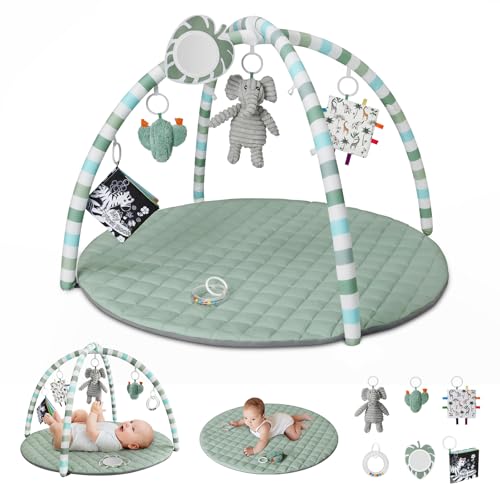
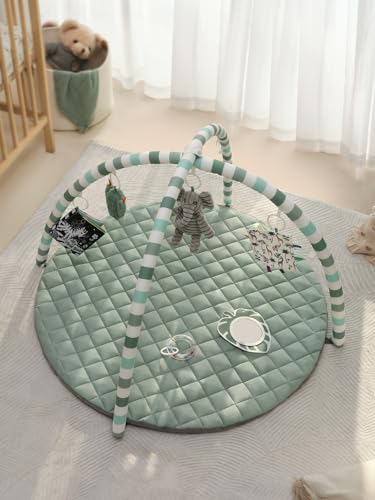
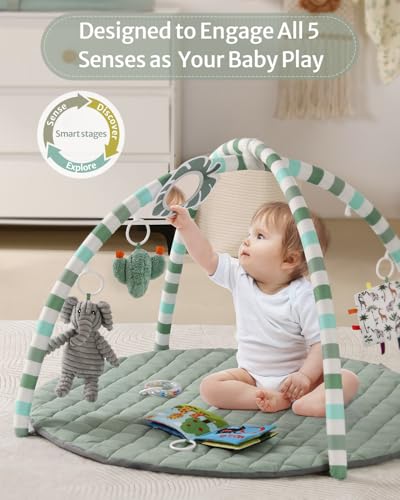
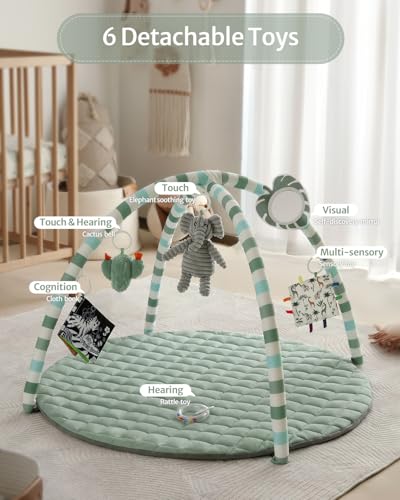
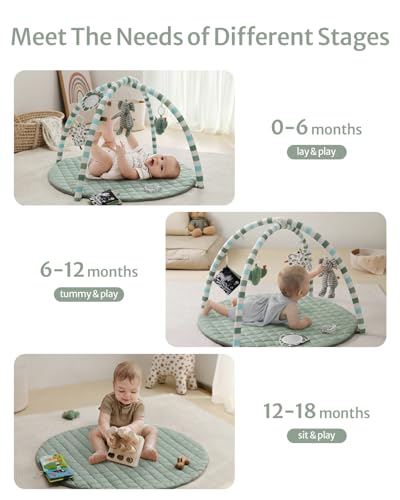
Blissful Diary Baby Play Gym Mat, Play Mat Activity Mat with 6 Detachable Toys for Stage-Based Sensory & Motor Skill Development, Easy to Install & Clean, Baby Essentials Gift, Sage Green
- Newborn Baby Essentials - The baby play gym is designed to develop stage-based sensory and motor skill. The so
- All-Round Early Development - The activity gym has 6 detachable toys which fully engage 5 senses as your baby
- Easy to Assemble & Take Down - The tummy time activity mat's size is 33.46x33.46 inch, crafted using ethically
Today's action: If you already own an activity gym, check that it's positioned somewhere your baby can reach it for at least two independent play sessions today. If you're shopping, prioritise multi-mode gyms with a tummy time pillow and a kick-response element.
7. Red Flags: When to Talk to Your Paediatrician About Play and Development
Most babies develop at their own pace, but certain signs in the context of play and learning warrant a prompt conversation with your doctor. The CDC's "Learn the Signs. Act Early." programme provides the clearest guidance.
Developmental Red Flags by Age
By 4 months: - Doesn't follow moving objects with eyes - Doesn't smile at people - Doesn't bring hands to mouth - Doesn't push down with legs when feet are placed on a firm surface
By 6 months: - Doesn't try to reach for things - Shows no affection for caregivers - Doesn't respond to sounds
By 9 months: - Doesn't babble ("mama", "baba", "dada" sounds) - Doesn't play any back-and-forth games - Doesn't respond to their name
By 12 months: - No words at all - No gestures (waving, pointing, showing) - Loses skills they previously had (this is always a reason to call)
Today's action: Screenshot the age-appropriate red flags above and save them to your phone. Check in with the list at your baby's next well-child visit.
Expert Insights
Conclusion
The first year goes by in a blur of feeds, nappy changes, and sleepless nights — and right in the middle of all that beautiful chaos, your baby is doing the most extraordinary cognitive work of their entire life. You don't need a curriculum, a programme, or a room full of expensive toys. You need your voice, your face, your willingness to get down on the floor and follow their lead.
The best thing you can do today is simpler than you think: put your baby on their tummy, get down to eye level, and talk to them like they understand every word — because in the ways that matter most, they do.
Play is not preparation for life. At this age, play is life. Save this guide, share it with your co-parent or childminder, and revisit it each month as your baby grows into new stages.
Sources & References
- American Academy of Pediatrics. "The Power of Play: A Pediatric Role in Enhancing Development in Young Children." Pediatrics, 2018. https://doi.org/10.1542/peds.2018-2058
- Harvard Center on the Developing Child. "Serve and Return Interaction Shapes Brain Circuitry." 2023. https://developingchild.harvard.edu/science/key-concepts/serve-and-return/
- Centers for Disease Control and Prevention. "Learn the Signs. Act Early. Developmental Milestones." 2022. https://www.cdc.gov/ncbddd/actearly/milestones/index.html
- Jennings, J.T. et al. "Recommended Tummy Time for the Healthy Full-Term Infant: Developmental and Clinical Considerations." Pediatric Physical Therapy, 2005. https://doi.org/10.1097/01.pep.0000186512.48529.a7
- Gilkerson, J. et al. "Mapping the Early Language Environment Using All-Day Recordings and Automated Analysis." American Journal of Speech-Language Pathology, 2017. https://doi.org/10.1044/2016_AJSLP-15-0169
- Zentner, M. & Eerola, T. "Rhythmic engagement with music in infancy." Proceedings of the National Academy of Sciences, 2010. https://doi.org/10.1073/pnas.1000121107
- Trainor, L.J. et al. "Interactive Music Experience Boosts Socio-Cognitive Development." University of Washington Institute for Learning & Brain Sciences, 2016. https://ilabs.uw.edu
- Zero to Three. "Brain Development: Frequently Asked Questions." 2023. https://www.zerotothree.org/resource/brain-development-frequently-asked-questions/
- American Academy of Pediatrics. "Media and Young Minds." Pediatrics, 2016. https://doi.org/10.1542/peds.2016-2591
Frequently Asked Questions
How much play does a 3–12 month old actually need?
Is it okay to use a bouncer or swing instead of floor play?
When should I introduce a play gym?
My baby seems bored with their toys after a week. What should I do?
Can too much stimulation harm my baby's development?
Does music really help brain development in infants?
What if I can't afford activity gym toys?
Was this helpful?
Thanks — your feedback helps us pick what to write next.