What "Montessori" Actually Means for Infants — and Why It Matters
Montessori toys for infants aged 3–12 months work best when they are simple, sensory-rich, and sized for small hands — the right pick supports motor development, cause-and-effect learning, and language foundations all at once.
In this article
Your baby just grabbed a wooden spoon off the kitchen counter and stared at it with the intensity of a scientist discovering a new element. That moment — that pure, self-directed curiosity — is exactly what the Montessori method is built around.
Here's a number that puts it in perspective: the first year of life sees the brain produce more than 1 million new neural connections every second, according to the Harvard Center on the Developing Child. The toys your infant reaches for, mouths, shakes, and drops during this window aren't just entertainment — they are literally shaping the architecture of their developing brain.
In this guide you'll understand:
1. What "Montessori" Actually Means for Infants — and Why It Matters
Montessori for infants is not about flashcards or early academics. It is about giving your baby an environment where they can act on the world and see what happens.
Dr. Maria Montessori described the infant mind as an "absorbent mind" — one that soaks up sensory information from the environment without effort or instruction. In practical terms, this means the best infant toys are the ones that respond to your baby's actions: a rattle that makes a sound when shaken, a ball that rolls when pushed, a ring that resists when pulled. Each of these tiny feedback loops teaches cause and effect, the most foundational cognitive skill of infancy.
The Three Core Principles That Guide Toy Selection
- Child-led exploration: The toy should respond to the child, not the other way around. Avoid toys that "perform" with lights and sounds regardless of what the baby does. - Natural, real-world materials: Wood, cotton, silicone, and natural rubber connect babies to the physical world and offer varied sensory feedback that plastic alone cannot. - Developmentally matched challenge: A toy that is too easy bores; one that is too hard frustrates. The sweet spot — a concept Vygotsky called the "zone of proximal development" — is where learning happens.
2. Months 3–6: Sensory Awakening and the First Grasps
Between three and six months, your baby's world explodes. Vision sharpens from blurry shapes to recognisable faces and high-contrast patterns. Hands open from tight fists to deliberate reaches. This is the window to flood the senses — carefully.
The American Academy of Pediatrics (AAP) notes that by four months most infants can track moving objects, bring hands to midline, and begin intentional reaching. Toys that meet these emerging abilities build the visual tracking and hand-eye coordination that underpin every physical skill that follows.
What to Look For at This Stage


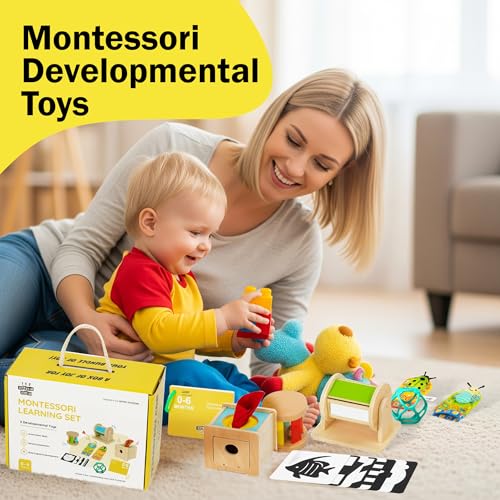
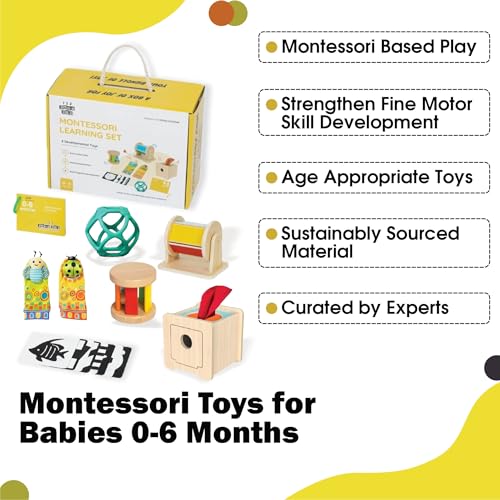
Montessori Toys for Babies 0-6 Months - 6-in-1 Educational Sensory Development Kit with Rolling Bell, Magic Tissue Box, Spinning Drum & More
- COMPREHENSIVE SET: 6-piece 123 BABY BOX Montessori learning set including Rolling Bell, Magic Tissue Box, Spin
- DEVELOPMENTAL FOCUS: Expertly designed toys that enhance fine motor skills, sensory exploration, logical think
- SAFE CONSTRUCTION: Made from high-quality wooden and child-safe materials, each toy is sized appropriately for
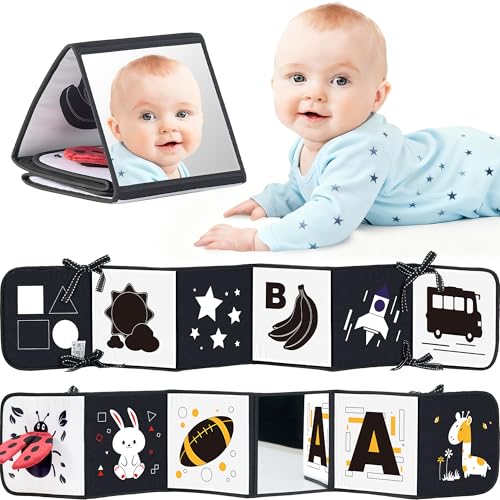
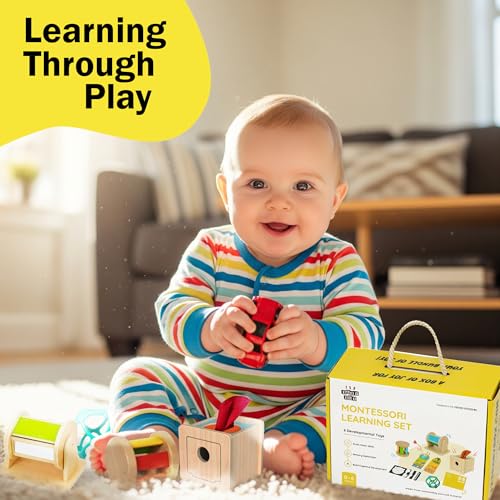
The 123 BABY BOX 6-in-1 Sensory Kit is purpose-built for this exact window. Its rolling bell, black-and-white cards, and gripping ball teether cover visual stimulation, auditory cause-and-effect, and early grasping in one set — no batteries, no assembly, and made from child-safe wood and non-toxic materials. At 4.8 stars from verified buyers, it's one of the stronger options in this age bracket.
3. Months 6–9: Cause, Effect, and the Joy of Dropping Things
If your six-month-old has discovered that dropping a spoon off the high chair tray makes you pick it up (repeatedly), congratulations — you're living with a scientist. This stage is defined by intentional object manipulation, early object permanence, and the first real understanding that actions have predictable consequences.
The WHO's developmental milestones framework identifies this period as critical for fine motor refinement: babies begin transferring objects hand-to-hand, exploring objects with their mouths, and banging surfaces to produce sound.
Toys That Earn Their Place at This Stage


Wuzhineisn Montessori Baby Toys for Ages 6-18 Months - Pull String Teether, Stacking Blocks, Sensory Shapes Storage Bin, Infant Bath Time Fun, 4 in 1 Toddlers Toy Gifts for 1 2 3 Year Old Boys Girls
- 4 in 1 Montessori Toys Set: Enhance your baby's development with our comprehensive babies toy set featuring bu
- Pull String Infant Toys: Adorable crab-shaped baby teething toy designed with 6 silicone pull cords of varying
- Building Blocks / Stacking Rings Toys: Our building toys feature embossed animal, fruit, and geometric pattern
The Wuzhineisn 4-in-1 Montessori Baby Toy Set hits almost every checkbox for this window. The crab-shaped pull-string teether with six silicone cords of varying thickness directly targets grip strength and oral sensory needs. The embossed building blocks and five-ring stacker introduce shape, colour, and early spatial reasoning — all in one $25.99 set with 878 verified reviews averaging 4.6 stars.
4. Months 9–12: Standing, Sorting, and Problem-Solving Begins
By nine months, most babies are pulling to stand, cruising furniture, and showing the first signs of intentional problem-solving — turning an object over to find the interesting side, trying different approaches when something doesn't work. This is the beginning of executive function, and it's the stage where toy complexity can meaningfully increase.
The CDC's developmental milestones for nine months include: picking up small objects with thumb and forefinger (the pincer grasp), banging objects together, and looking for hidden objects — the hallmark of object permanence.
What to Introduce Now
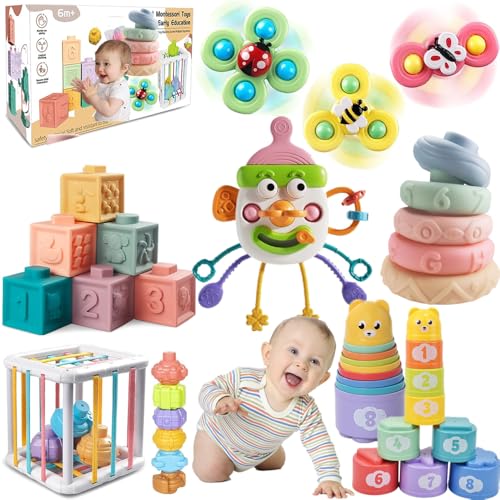
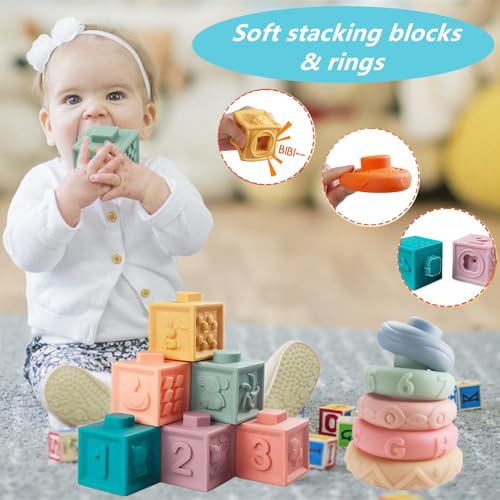
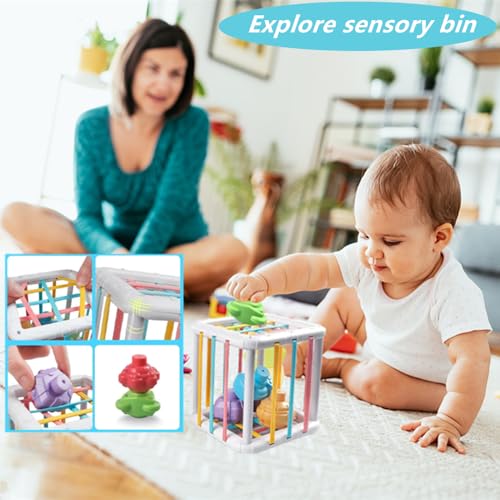

ELLECK Baby Toys 6-12 Months, Montessori Toys for Toddlers 1-3 Year Old, Busy Cube Teether Infants Bath 6 in 1 Stacking Blocks Rings, Suction Cup Spinner, Shape Bin Sensory (0035)
- BABY TOYS SET : The baby toys set contains building blocks, Travel Activities Busy Board Cube, stacking cups,
- EARLY LEARNING TOY FOR BABIES : This Montessori Busy toys includes 6 activity panels that offer different expe
- SAFETY FIRST : Our Montessori toys for babies 6-12 months are made with premium quality, 100% safe and high qu
The ELLECK 6-in-1 Busy Cube and Stacking Set is a strong pick here. Six activity panels — each with a different challenge — keep a nine-to-twelve-month-old engaged without requiring adult direction. The suction cup spinner adds a satisfying resistance element that trains grip and wrist rotation. BPA-free, phthalate-free, and ASTM-certified at $23.99 with 420 reviews at 4.7 stars.
For babies at the older end of this window, the Aprilwolf Shape Sorting Cube ($12.99, 4.7★, 1155 reviews) is an outstanding value entry point into shape sorting — six textured colour blocks, elastic-band resistance, and a satisfying push-and-pull motion that builds pincer grasp and spatial reasoning simultaneously.
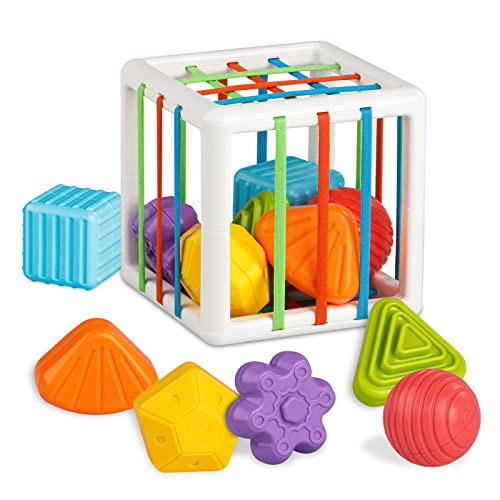
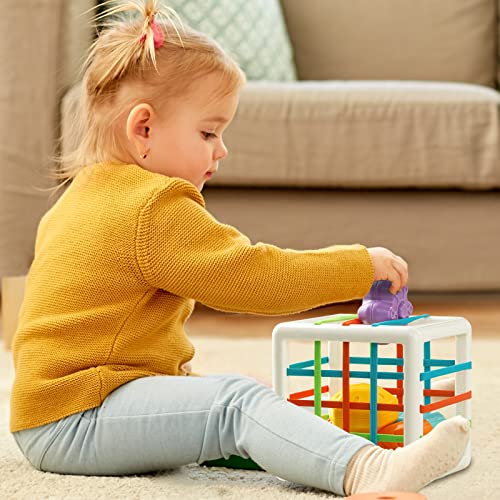
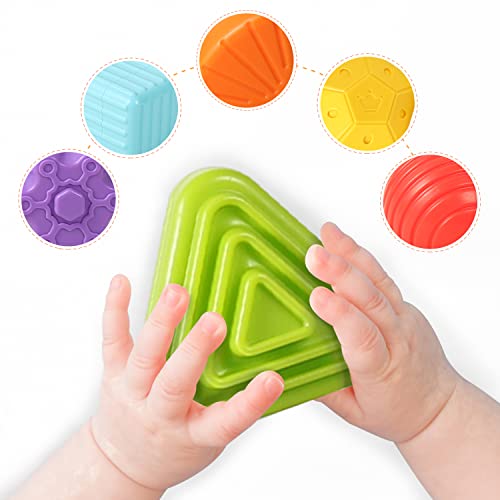

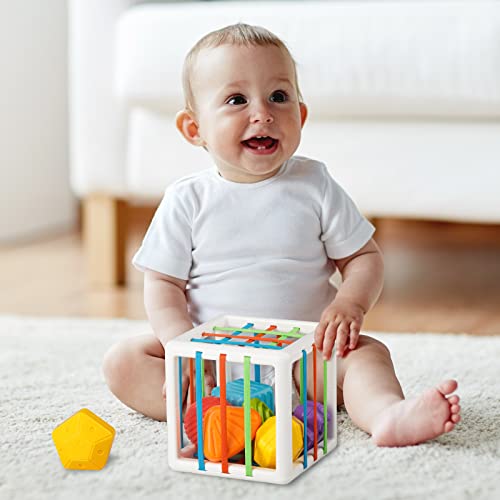
Aprilwolf Montessori Toys for 1 Year Old, Cube & 6 Sensory Shape Blocks, Baby Toys 12-18 Months, Developmental Infant Birthday Gifts for Learning Toddler Age 1 2 3
- 【Shape sorting cube】6 color shape blocks with different textures, and a cube with elastic bands and space, thi
- 【Spatial reasoning】When infants get the blocks and the cube, they would be curious what they can do with it. I
- 【Fine motor skills】Doing the push and pull motion, helps baby to develop Hand-eye coordination
5. Choosing Safe, Sustainable Montessori Toys: What the Labels Actually Mean
Safety is not a marketing differentiator — it is the baseline. And in the infant toy space, the labelling can be genuinely confusing.
A Quick Checklist Before You Buy
| Toy Type | Best Age Range | Primary Developmental Benefit | Key Safety Check | Recommended Product | Price |
|---|---|---|---|---|---|
| Sensory rattle / rolling bell | 0–6 months | Auditory cause-and-effect, visual tracking | No small detachable parts; weight under 100g | 123 BABY BOX Sensory Kit | $49.99 |
| Pull-string teether | 6–9 months | Grip strength, oral sensory, cause-and-effect | Food-grade silicone; cords securely attached | Wuzhineisn 4-in-1 Set | $25.99 |
| Stacking rings | 6–12 months | Spatial reasoning, colour recognition, bilateral hands | Soft, chewable material; no sharp edges | Meytccve 6-in-1 Set | $35.99 |
| Activity / busy cube | 9–12 months | Fine motor, problem-solving, sustained attention | BPA-free; ASTM certified; no pinch points | ELLECK 6-in-1 Busy Cube | $23.99 |
| Shape sorting cube | 10–12 months | Pincer grasp, spatial rotation, shape discrimination | Block sizing above choke threshold | Aprilwolf Shape Sorting Cube | $12.99 |
| Wooden stacking blocks + xylophone | 12+ months | Musical exploration, stacking, early numeracy | Smooth wood finish; non-toxic paint | hahaland Wooden Brain Block Set | $16.14 |
6. How to Integrate Montessori Toys Into Your Baby's Daily Routine
The best toy collection in the world gathers dust without intentional integration. Montessori at home is less about the toys themselves and more about the environment you create around them.
Practical Setup for a Montessori-Friendly Play Space
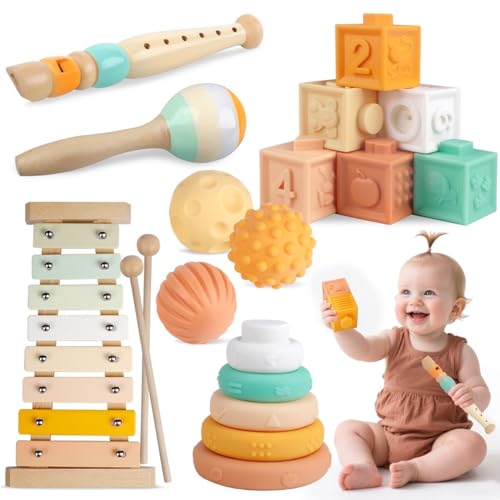
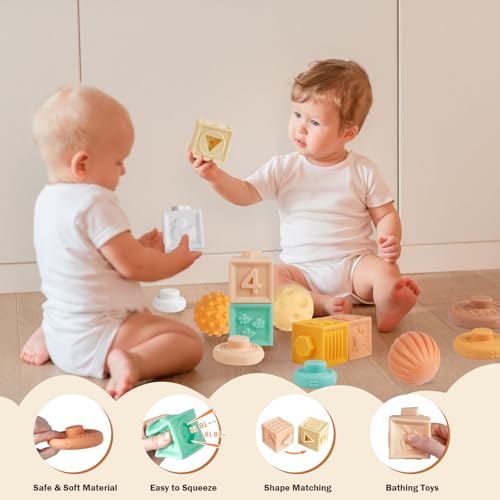
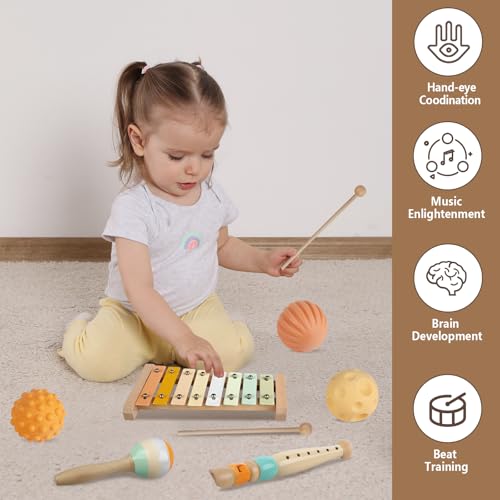
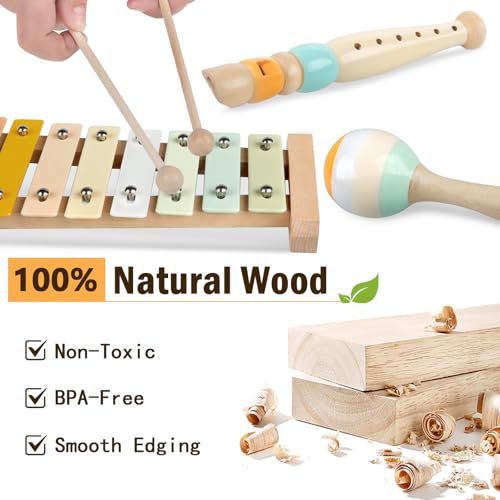
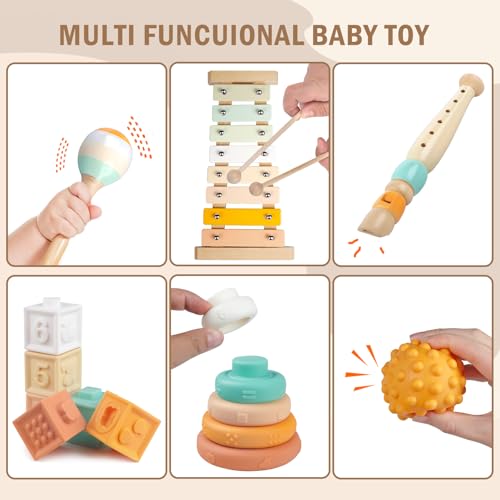
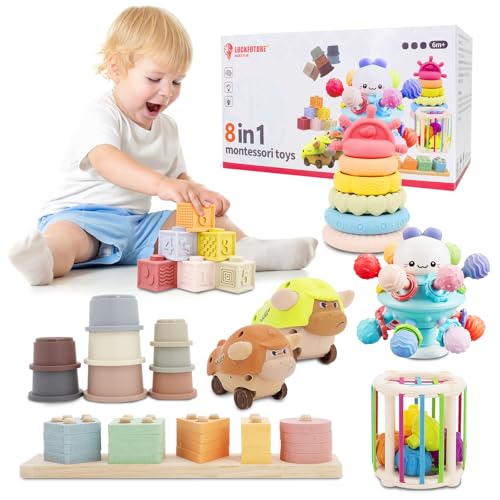
Meytccve Baby Toys Montessori Toys for Babies 1-3,Wooden Musical Instruments Toy Stacking Building Blocks,Infant Teething Toys Sensory Balls,Xylophone,Birthday Gift for Toddlers 1+ Year Old
- Perfect for 1-3 Year old Toys Collection. This 6-in-1 baby toy set is designed to grow with your child, making
- Montessori Toys for Baby - Encourages Sensory Learning Inspired by Montessori principles, this toy set promote
- First Birthday Gifts & Baby Gift Ideas Looking for the perfect first birthday gifts or baby gifts? This 6-in-1
The Meytccve 6-in-1 Wooden Musical and Sensory Set works beautifully as a "rotation anchor" — the xylophone and drum panels introduce sound-making play that older infants return to repeatedly, while the silicone stacking rings satisfy the tactile and chewing needs of younger babies in the same set. It grows with your child from 6 to 18 months, reducing the need for frequent replacement purchases.
Expert Insights
There is something quietly profound about watching your baby spend eight focused minutes turning a wooden ring over in their hands, mouthing it, passing it from one hand to the other, and finally setting it down with the satisfied expression of someone who has learned something. No screen produced that moment. No battery powered it.
The right Montessori toy doesn't just keep your baby busy — it hands them a small piece of the world and says, figure this out. And they do. Every single time.
Save this guide for the next time you're standing in a toy aisle or scrolling at midnight, wondering whether any of it actually matters. It does — and now you know exactly what to look for.
Sources & References
- Harvard Center on the Developing Child. "Brain Architecture." 2023. https://developingchild.harvard.edu/science/key-concepts/brain-architecture/
- American Academy of Pediatrics (AAP). "Developmental Milestones: 4 Months." HealthyChildren.org. 2023. https://www.healthychildren.org/English/ages-stages/baby/Pages/Developmental-Milestones-4-Months.aspx
- Centers for Disease Control and Prevention (CDC). "Developmental Milestones: 9 Months." 2023. https://www.cdc.gov/ncbddd/actearly/milestones/milestones-9mo.html
- World Health Organization (WHO). "Nurturing Care for Early Childhood Development." 2018. https://www.who.int/publications/i/item/9789241514064
- Garner, A.S., et al. "Thinking Developmentally: Nurturing Wellness in Childhood to Promote Lifelong Health." American Academy of Pediatrics. 2019.
- Radesky, J., et al. "Talking Points: Responding to Parent Questions About Media and Young Children." AAP Council on Communications and Media. Pediatrics. 2020.
- Davies, Simone. "The Montessori Baby." Workman Publishing. 2021.
- Klein, Tovah P. "How Toddlers Thrive." Touchstone. 2014.
- Kuhl, P.K. "Brain Mechanisms in Early Language Acquisition." Neuron, University of Washington Institute for Learning & Brain Sciences (I-LABS). 2010. https://doi.org/10.1016/j.neuron.2010.08.038
- U.S. Consumer Product Safety Commission. "ASTM F963 Standard Consumer Safety Specification for Toy Safety." 2023. https://www.cpsc.gov/Business--Manufacturing/Business-Education/Toy-Safety
Frequently Asked Questions
Are Montessori toys really better than regular toys for infants?
At what age can I start Montessori toys?
How many toys does an infant actually need?
Are wooden toys safe for babies who mouth everything?
What's the difference between a "Montessori toy" and a regular educational toy?
Should I buy a set or individual Montessori toys?
How do I know if a toy is developmentally appropriate for my baby's current stage?
Was this helpful?
Thanks — your feedback helps us pick what to write next.