Why the Preschool Years Are the Sweet Spot for Building Play
Magnetic building blocks are one of the most developmentally rich toys you can give a preschooler — they build spatial reasoning, fine motor skills, and early STEM foundations through open-ended, screen-free play.
In this article
Picture this: it's a rainy Tuesday afternoon, your four-year-old has declared every other toy "boring," and you're twenty minutes from losing the battle to the tablet. You hand over a box of magnetic blocks. Within minutes, they're deep in concentration — tongue out, brow furrowed — stacking a tower taller than their own head. That's not just cute. That's neuroscience in action.
Research published by the American Academy of Pediatrics (AAP) confirms that hands-on, open-ended play is one of the most powerful drivers of cognitive development in children under six. Spatial reasoning skills built during the preschool years have been linked to later achievement in mathematics, engineering, and problem-solving — and block play is one of the most accessible ways to build them.
In this guide, you'll understand:
1. Why the Preschool Years Are the Sweet Spot for Building Play
The ages of three to five represent one of the most active periods of brain development your child will ever experience. Neural pathways are forming rapidly, and the experiences children have during this window quite literally shape the architecture of their developing brain.
Block play — and magnetic construction in particular — lands right at the intersection of several developmental priorities for this age group. When your child picks up a magnetic tile, rotates it to find the right connection, and places it deliberately onto a structure, they are practising spatial visualisation, fine motor control, cause-and-effect reasoning, and persistence — all at once.
Spatial Reasoning: The Skill That Predicts Future Success
A landmark meta-analysis published in Psychological Science (Uttal et al., 2013) found that spatial reasoning skills are not fixed — they are highly trainable, and early intervention through play has lasting effects. Children who engage in regular construction play show measurable improvements in mental rotation, spatial visualisation, and pattern recognition.
For preschoolers specifically, magnetic tiles offer something traditional wooden blocks don't: forgiving connections. The magnet does some of the work, which means a three-year-old with developing fine motor skills can still achieve satisfying, stable structures — keeping frustration low and engagement high.
2. How Magnetic Building Blocks Actually Support STEM Learning
"STEM toy" is one of the most overused phrases in children's retail — but in the case of magnetic building blocks, the label genuinely holds up when you look at what children are actually doing during play.
The Four STEM Pillars in a Single Play Session
Science: Children discover magnetic polarity — that pieces attract or repel — without a single lesson. They test hypotheses ("will this stick?") and observe outcomes. That's the scientific method, preschool edition.
Technology: Understanding that design choices affect outcomes (a wide base makes a taller tower possible) is foundational engineering-technology thinking.
Engineering: Every structure a child builds involves load-bearing decisions. Why did it fall? What can I change? These are genuine engineering questions.
Mathematics: Sorting by shape, counting pieces, recognising that two triangles make a square — preschoolers encounter geometry, number sense, and pattern recognition organically.
For a set that layers storytelling onto STEM construction — a powerful combination for preschool-age imagination — the GobiDex 108PCS Magnetic Blocks & Figures Crew Playset blends building with character-driven narrative play, which research shows accelerates language development alongside spatial skills.


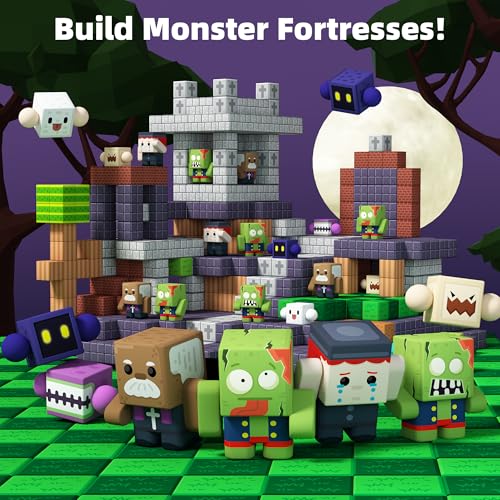
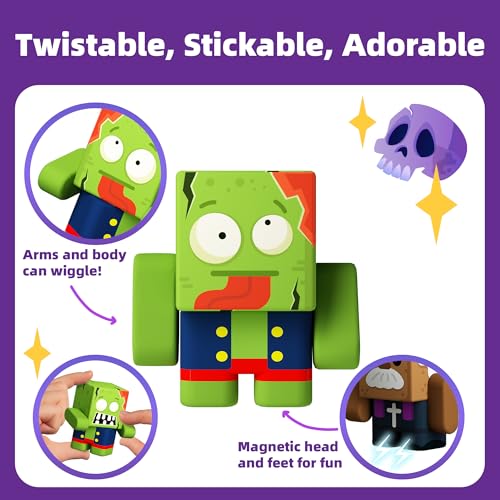
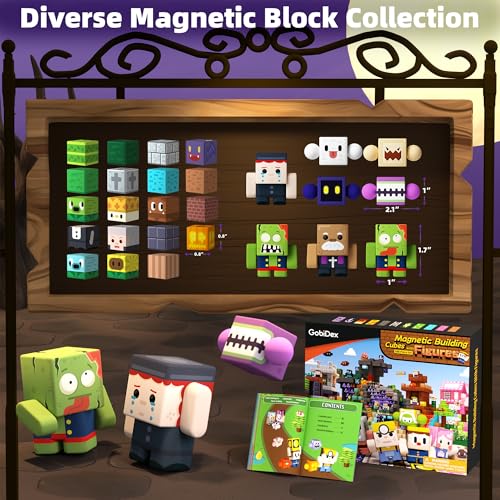
GobiDex 108PCS Magnetic Blocks & Figures Crew Playset, Build Weird Monster MagWonder with STEM Building Toys, Pretend Play Montessori Gift for Boys and Girls 3+ Years Old
- Magnetic Design & Safe Materials: With magnetic design enabling automatic adhesion and flexible rotation, the
- Varied Block Selection: By blending villagers, monsters, walls, and vegetation to create a fantastical and mys
- STEM Education: As typical educational toys and engaging STEM toys, sensory play lets kids develop color recog
3. Choosing the Right Magnetic Block Set for Ages 3–5
Not all magnetic building toys are created equal, and the differences matter enormously at this age. Here's what to actually evaluate before you buy.
Piece Size and Safety First
For children aged three to five, piece size is a non-negotiable safety consideration. The Consumer Product Safety Commission (CPSC) mandates that toys for children under three must pass a choke-hazard test, but for three-to-five-year-olds — who may still mouth objects — you want pieces that are clearly too large to swallow and have fully encased magnets.
Loose or exposed magnets are a serious medical hazard. The CPSC has issued multiple warnings about high-powered loose magnets: if two are swallowed separately, they can attract through intestinal walls and cause life-threatening perforations. Always check that magnets are fully embedded and sealed.
Piece Count and Shape Variety
For a first set, 24–60 pieces is the right range for a preschooler. Too few and play becomes repetitive; too many and set-up becomes overwhelming. A mix of squares and triangles is the classic starting point — triangles create stability (think pyramids and rooftops) while squares form walls and floors.
The Geomag Magicube Magnetic Blocks are worth a mention here: Swiss-made, designed specifically for ages 1–5, with large cube-format pieces that are genuinely easy for small hands to grip and connect. At 4.5 stars across over 1,100 reviews, they represent one of the most trusted entry-level options on the market.
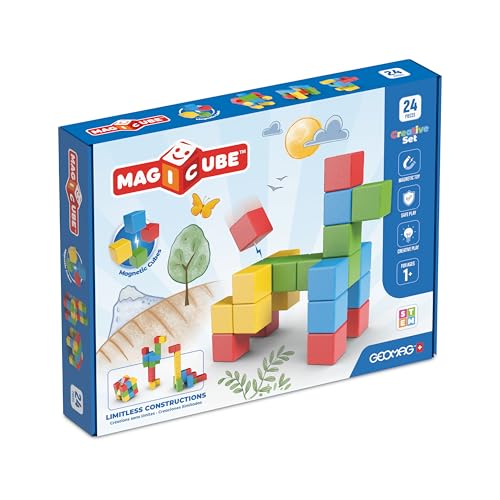
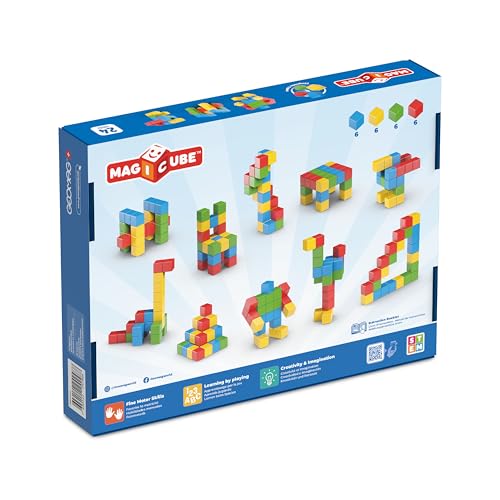
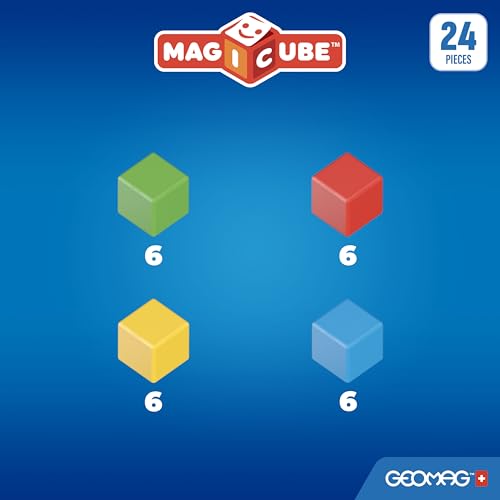
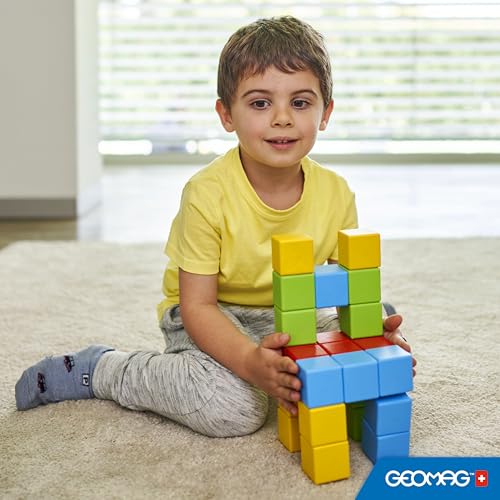
Geomag Magicube Magnetic Blocks for Toddlers Ages 1–5 | Swiss-Made STEM Building Toy Sets | Multiple (MAGICUBE_24PCS_Montessori)
- Magnetic building blocks designed for toddlers and young children to explore creativity through hands-on play.
- Encourages early STEM development, problem-solving, spatial awareness, and fine motor skills through interacti
- Designed for ages 1–5 with large, easy-to-handle cubes that are safe and simple for little hands.
4. Themed Sets vs. Classic Tiles: Which Works Better for Preschoolers?
Classic flat magnetic tiles (squares and triangles) are the industry standard — and for good reason. But a newer category of themed magnetic cube sets has emerged, and for the preschool age group, the distinction matters.
Classic Flat Tiles
These are the Magna-Tiles style sets: flat geometric shapes with magnets along the edges. They connect face-to-face and edge-to-edge, enabling both flat mosaic play and 3D construction. They're excellent for spatial reasoning because children must mentally rotate and position each piece.
Best for: children who enjoy structured building, love architecture, and have some prior block experience.
Magnetic Cubes
Cube-format sets (typically 0.8-inch cubes with magnets on multiple faces) are arguably more intuitive for the youngest builders. Any face connects to any face — there's less spatial planning required, which means three-year-olds experience success faster.
The Mileonaim 100PCS Portal-Themed Magnetic Cubes add a clever sensory layer: each cube produces a soft bell-like sound when connected. For children who are auditory learners or who have sensory processing differences, this kind of multi-sensory feedback can be genuinely engaging.
The MUUHU 300PCS Magnetic Blocks offer exceptional value for families who want a large cube-format set — 300 pieces means siblings can build simultaneously without fighting over pieces, and the sheer quantity encourages large-scale collaborative construction.
Themed Story Sets
Sets that include figures, characters, or narrative elements — like the GobiDex Magnetic Blocks & Figures Playset — bridge construction play and imaginative storytelling. This is developmentally powerful: the AAP notes that pretend play and construction play together support language, social-emotional development, and creativity more than either alone.
5. A Parent's Comparison Guide: Which Set for Which Child?
| Set Type | Best Age | Key Strength | Watch Out For | Recommended Product | Price Range |
|---|---|---|---|---|---|
| Large Magnetic Cubes (24pc) | 1–4 yrs | Easiest grip, safest for youngest | Limited structural complexity | Geomag Magicube 24PCS | $35–45 |
| Themed Cube Set with Figures | 3–6 yrs | Storytelling + STEM in one | Smaller figures may need supervision | GobiDex 108PCS Crew Playset | $18–25 |
| Portal-Themed Cube Set (100pc) | 3–8 yrs | Sensory sound feedback, guided themes | Smaller cube size — check supervision level | Mileonaim 100PCS Portal Cubes | $28–32 |
| Space-Themed LED Set (181pc) | 3–7 yrs | Glow + LED features extend play to evening | Higher price point | PLAYIQ 181PCS Space Set | $44–50 |
| Large Cube Set (200pc) | 3–10 yrs | Forest/building themes, great for groups | No flat tile geometry | QRPQT 200PCS Building World Set | $38–42 |
| Value Bulk Cube Set (300pc) | 3–10 yrs | Maximum piece count, sibling-friendly | Less thematic guidance | MUUHU 300PCS Magnetic Blocks | $28–32 |
6. Getting More STEM Value Out of Every Play Session
Buying the right set is step one. Getting the most developmental mileage out of it is step two — and this is where parents can make a real difference with very little effort.
Strategies That Actually Work
Narrate what you see. When your child builds, describe it: "You put the triangle on top of the square — that made a roof shape!" This kind of spatial language, used in the moment, has been shown in University of Chicago research to directly improve children's spatial reasoning scores.
Ask open questions, not leading ones. Instead of "Why don't you add another piece here?" try "What do you think would happen if...?" This builds metacognitive thinking — the ability to think about their own thinking.
Let structures fall. Resist the urge to stabilise a wobbling tower. The moment of collapse is one of the richest learning experiences in construction play: your child will immediately begin problem-solving why it happened.
Introduce a challenge. "Can you build something as tall as your knee?" or "Can you make a house for this toy figure?" Challenges extend play sessions and introduce goal-directed thinking — a key executive function skill.
The PLAYIQ 181PCS Space-Themed Magnetic Set is particularly well-suited to challenge-based play: its glow-in-the-dark aliens and LED light-up figures naturally prompt children to build "bases," "rocket ships," and "alien habitats" — narratives that extend engagement well beyond a typical play session.

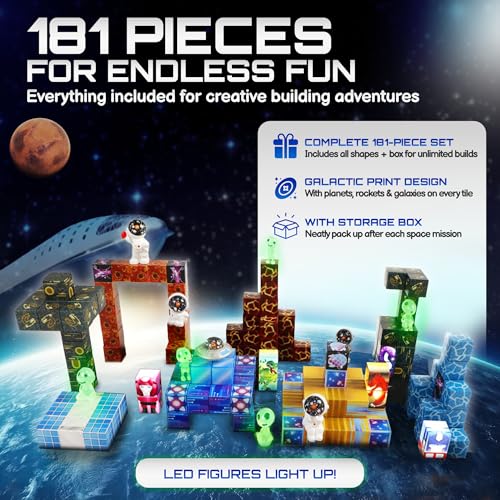
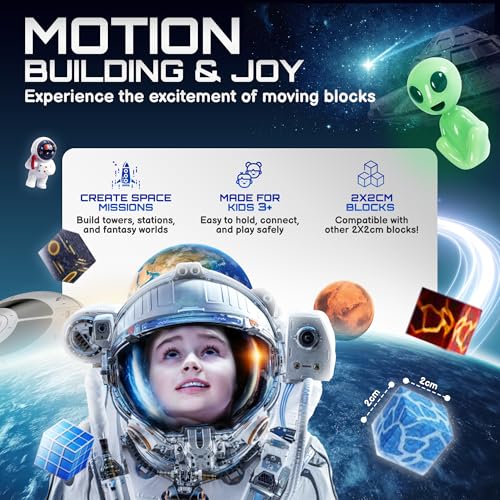
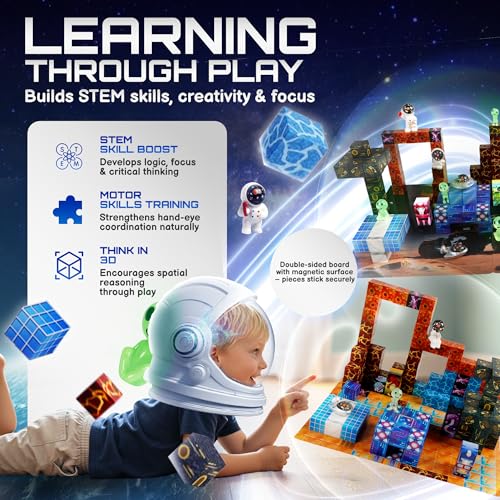
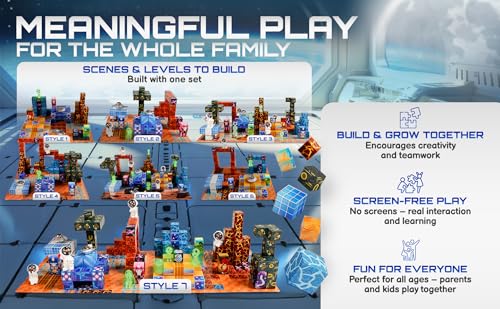
181-Piece Magnetic Building Blocks Set – STEM Toys for Kids Ages 3+ | Educational Space-Themed Magnetic Construction Kit with LED Light-Up Cubes | Sensory Gift Toy for Boys & Girls
- COMPLETE 181-PIECE SPACE-THEMED MAGNETIC BUILDING SET – Unlock endless creativity with galactic print magnetic
- GALACTIC GLOW-IN-THE-DARK ALIENS & LIGHT-UP FIGURES – Time to embark on an interstellar adventure! Unlike stan
- STEM LEARNING THROUGH PLAY – Supports STEM skill development, creativity, 3D thinking, and fine motor skills t
7. Safety, Durability, and What to Check Before Every Play Session
Magnetic building toys are among the safest construction toys available when they are well-made and age-appropriate — but there are specific things to check, especially as sets age.
Pre-Play Safety Checklist
Durability Considerations
Ultrasonic-welded plastic shells (the most common construction method in mid-range sets) are durable for normal play but can show wear after repeated high-impact drops or very heavy use. If you're buying for a classroom or group setting, consider sets with riveted construction or higher-gauge plastic.
The QRPQT 200PCS Magnetic Building Cube Toys and Mileonaim 100PCS Portal Cubes both specify non-toxic, BPA-free ABS plastic with fully encased magnets — a good baseline for any set you're considering.
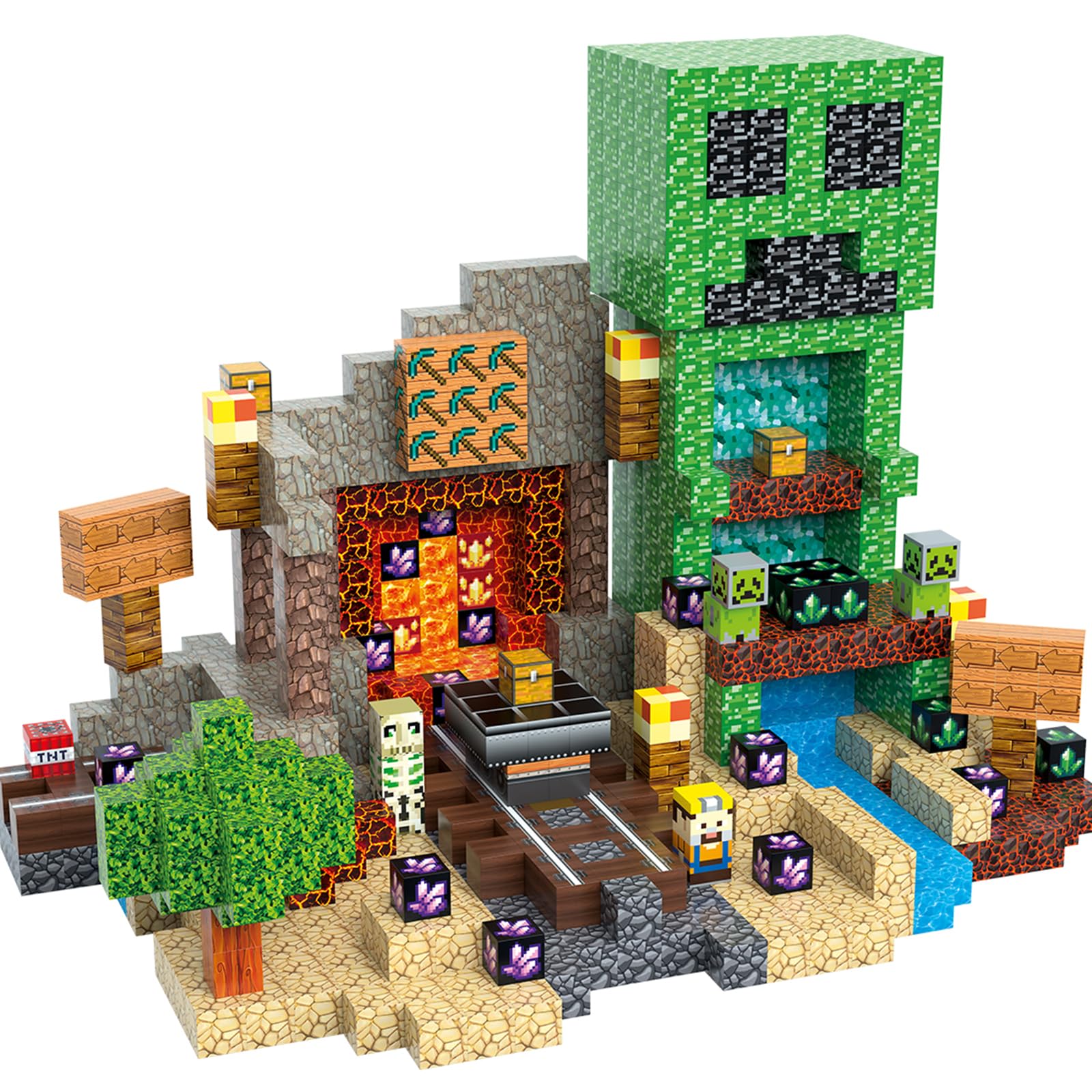

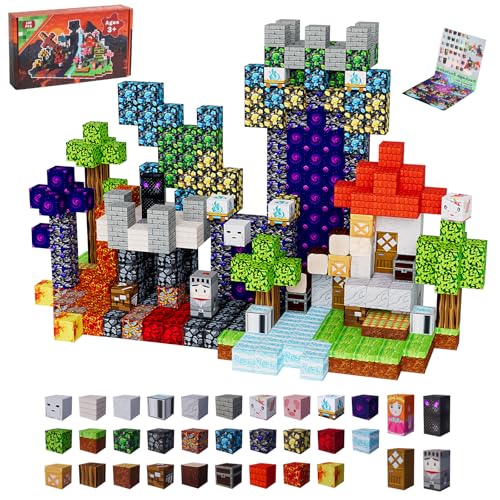
100PCS Magnetic Blocks Building Toys for Kids - 0.8in Magnet Cubes Portal Theme Toddler Toys, STEM Preschool Educational Sensory Construction Set, Birthday Gifts for Boys Girls Age 3-8
- 100PCS Portal-Themed Magnetic Adventure Set: Dive into a magical universe with 100 pieces of 0.8-inch magnetic
- Sensory Sound That Sparks Imagination: Each cube produces a satisfying bell-like rustling sound when connected
- Safe Durable & Toddler-Friendly Design: Made from non-toxic, BPA-free ABS plastic with fully encased, strong m
Expert Insights
The Click That Changes Everything
There's a particular moment every parent of a preschooler recognises: the moment your child figures something out entirely on their own. With magnetic building blocks, that moment comes often — a tower that finally stands, a roof that clicks into place, a structure that looks, unmistakably, like the thing they imagined.
Those moments aren't small. They are the building blocks — quite literally — of confidence, persistence, and a belief that problems can be solved. In a world that will increasingly demand creative, spatial, and analytical thinking, the best thing you can give a four-year-old might just be a box of magnets and an afternoon.
The most powerful STEM curriculum for a preschooler doesn't come with a screen — it clicks together on the living room floor.
If this guide helped you, save it for the next time someone asks what to buy for a three-year-old's birthday. They'll thank you for it.
Sources & References
- American Academy of Pediatrics. "The Power of Play: A Pediatric Role in Enhancing Development in Young Children." Pediatrics, 2018. https://publications.aap.org/pediatrics/article/142/3/e20182058/38649
- Uttal, D.H., et al. "The Malleability of Spatial Skills: A Meta-Analysis of Training Studies." Psychological Science, 2013. https://doi.org/10.1177/0956797612459592
- Levine, S.C., et al. "Early Puzzle Play: A Predictor of Preschoolers' Spatial Transformation Skill." Developmental Psychology, University of Chicago, 2012.
- Newcombe, N.S. "Picture This: Increasing Math and Science Learning by Improving Spatial Thinking." American Educator, Temple University, 2010.
- U.S. Consumer Product Safety Commission (CPSC). "Magnet Safety." https://www.cpsc.gov/Safety-Education/Safety-Education-Centers/Magnets
- Resnick, M. "Lifelong Kindergarten: Cultivating Creativity through Projects, Passion, Peers, and Play." MIT Press, 2017.
- Brown, S. "Play: How It Shapes the Brain, Opens the Imagination, and Invigorates the Soul." Avery/Penguin, 2009.
- ASTM International. "ASTM F963-23: Standard Consumer Safety Specification for Toy Safety." 2023. https://www.astm.org/f0963-23.html
Frequently Asked Questions
Are magnetic building blocks safe for 3-year-olds?
How many pieces does a preschooler actually need?
What's the difference between magnetic tiles and magnetic cubes?
Can magnetic blocks be used alongside other brands?
At what age should I introduce magnetic building blocks?
Do magnetic building toys actually help with school readiness?
How do I keep my child engaged with the same set over time?
Was this helpful?
Thanks — your feedback helps us pick what to write next.